
Sierra Leone is one of the world’s most resource-rich nations. Beneath its soil lie vast deposits of diamonds, gold, iron ore, and bauxite. Along its coastline are abundant fishing resources. Yet despite this natural wealth, much of the population continues to live in poverty, and the country remains among the least developed economies in the world.
How can a country so rich in resources remain so poor?
The answer lies not in a lack of wealth, but in history, politics, and the way those resources have been managed.
The Legacy of Colonial Rule
Many of the foundations for today’s challenges were laid during colonial rule. Under British administration, the economy was largely built around the export of raw materials. Infrastructure, trade systems, and government structures were designed primarily to extract resources rather than develop a broad and self-sustaining national economy.
When Sierra Leone gained independence in 1961, it inherited weak institutions, limited industrial development, and an education system ill-equipped for long-term economic growth.
The “Resource Curse”
Economists often use the term “resource curse” to describe countries that possess significant natural resources but continue to struggle with poverty and instability. Instead of creating widespread prosperity, resource wealth can fuel corruption, political competition, and economic dependency.
In Sierra Leone, much of the revenue from mining has historically been controlled by small political and economic elites. Weak institutions and widespread corruption have made it difficult to ensure that resource income benefits society as a whole.
At the same time, the country has become heavily dependent on raw material exports. When global commodity prices fall, the national economy suffers severely.
Civil War and “Blood Diamonds”
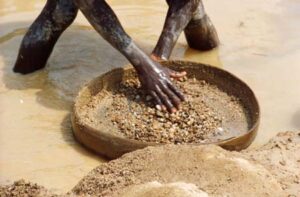
From 1991 to 2002, the country was devastated by a brutal civil war that killed tens of thousands of people and displaced large parts of the population. The conflict was partly financed through the trade in so-called “blood diamonds.”
The war destroyed schools, hospitals, roads, and public administration. Entire communities lost basic infrastructure, and public trust in the state was deeply damaged.
Even after the war ended, rebuilding institutions and restoring the economy has taken many years.
Foreign Companies and Weak Agreements
Natural resources in Sierra Leone are largely extracted by international companies. The issue is not necessarily foreign investment itself, but rather the government’s limited ability to negotiate favorable agreements or enforce effective taxation.
As a result, enormous value leaves the country, while local communities often see few jobs and limited economic development in return.
Lack of Investment in People
Another major factor is the long-standing underinvestment in education, healthcare, and infrastructure. Many parts of the country still lack reliable roads, electricity, and access to clean water.
Without these basic investments, it becomes difficult to develop industries, technology sectors, and other forms of economic activity beyond mining.
Crisis After Crisis
As if war and poverty were not enough, the country was also hit hard by the West African Ebola outbreak in 2014. The epidemic caused thousands of deaths and severely disrupted economic progress.
Countries with fragile healthcare systems are often far less capable of handling such crises.
Not a Lack of Wealth — but a Lack of Strong Institutions
The story of Sierra Leone demonstrates that natural resources alone do not create prosperity. Equally important are strong institutions, political stability, investment in education, and the ability to distribute wealth across society.
Several countries have shown that long-term development is possible, but it requires effective governance, accountability, and trust between the state and its people.
For Sierra Leone, the challenge is therefore not the absence of wealth beneath the ground — but how the wealth above ground is managed.

Leave a Reply